nouveau blog
Lors de l'achat d'un nouveau vélo de route, le choix du matériau du cadre est une décision cruciale. Ce choix influence tout, du comportement et de la maniabilité du vélo au poids, à la durabilité et au prix. Chaque matériau offre des caractéristiques uniques qui peuvent améliorer ou dégrader votre expérience de cyclisme selon vos besoins et préférences.
Dans ce guide complet, nous allons détailler les quatre principaux matériaux utilisés pour les cadres de vélos de route — fibre de carbone, aluminium, acier et titane — afin de vous aider à prendre une décision éclairée qui corresponde à votre style de cyclisme, à vos objectifs de performance et à votre budget.
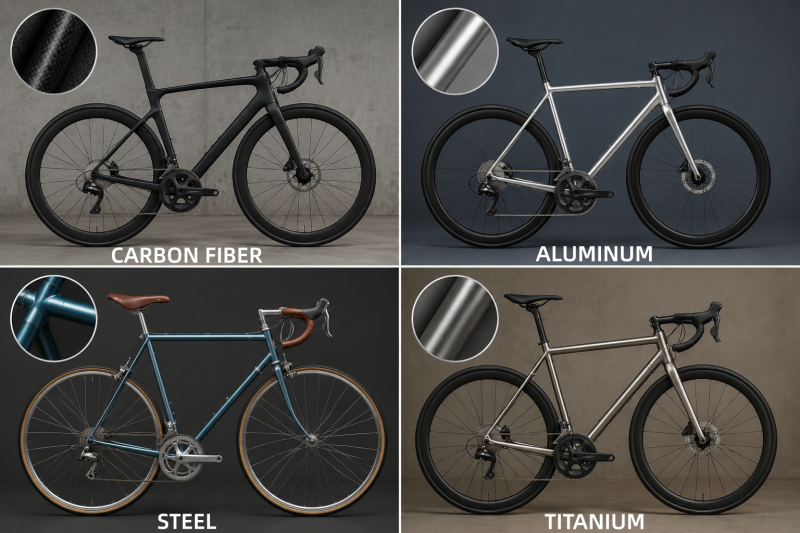
La fibre de carbone est devenue le matériau dominant pour les vélos de route haute performance. Contrairement aux cadres métalliques, les cadres en fibre de carbone sont fabriqués à partir de feuilles de carbone superposées, liées par de la résine et polymérisées sous pression dans des moules.
Cyclistes de performance, coureurs et cyclistes recherchant légèreté, efficacité et qualité de conduite optimale.
L'alliage d'aluminium est largement utilisé dans les vélos de route d'entrée et de milieu de gamme en raison de son excellent rapport coût-performance.
Pour les débutants, les vélos d'entraînement et les cyclistes recherchant des performances fiables à un prix abordable.
L'acier reste un matériau de prédilection pour les cyclistes traditionnels en raison de son confort, de sa durabilité et de ses sensations de conduite classiques.
Cyclotourisme, endurance, bikepacking et cyclistes qui privilégient le confort et la tradition.
Le titane est considéré comme un matériau de cadre haut de gamme qui allie confort, résistance et durabilité exceptionnelle.
Cyclistes d'endurance haut de gamme à la recherche d'un cadre d'investissement à vie.
Il n'existe pas de matériau de cadre idéal pour tous les cyclistes. Chaque option présente des avantages uniques selon le style de conduite, les besoins en confort et le budget.
Au final, le meilleur vélo est celui qui vous donne envie de rouler plus souvent, qu'il s'agisse d'un vélo de course en carbone, d'un vélo d'entraînement durable en aluminium, d'un cadre classique en acier ou d'un modèle haut de gamme en titane.
Suivez nous :


-- obtenir des mises à jour avec les derniers sujets

 email
email français
 English
 Deutsch
 русский
 italiano
 español
 português
 العربية
 日本語
日本語 한국의
한국의 中文
中文