
 email
 français
 English
 Deutsch
 русский
 italiano
 español
 português
 العربية
 日本語
 한국의
 中文


In polymer processing, the melting point and glass transition temperature (Tg) are often confused on the production floor. But what role do these two critical transition points actually play in process adjustment and material modification?
Understand the Basics: What Type of Plastic Are You Working With?
Confusion between these two temperatures often stems from a failure to distinguish between different polymer structures. In terms of physical structure, plastics are generally divided into two main categories:
Amorphous Plastics
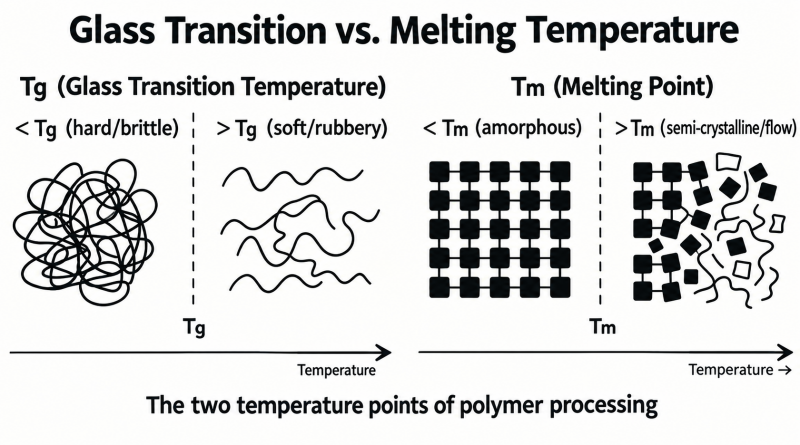
The first category is fully amorphous plastics, such as PS, PMMA, PC, PVC, and ABS. Their molecular chains are arranged in a disordered, tangled structure, with no regularly ordered crystalline regions. Therefore, they have a glass transition temperature (Tg), but no true melting point (Tm).
In practice, you may hear people refer to the "melting point of PC" as being above 200°C. Technically, this is more accurately described in terms of the flow temperature (Tf) or processing flow temperature. Don't get too caught up looking for a true Tm in the material datasheet.
Semi-Crystalline Plastics
The second category is semi-crystalline plastics, such as PE, PP, PA, PET, POM, and crystalline grades of PLA. Their internal structure consists of both regularly ordered crystalline regions and disordered amorphous regions. As a result, they have both Tg and Tm.
Once you understand this distinction, the different roles of these two temperatures become much easier to grasp.
Tg (Glass Transition Temperature): When Polymer Chains Begin to "Stretch"
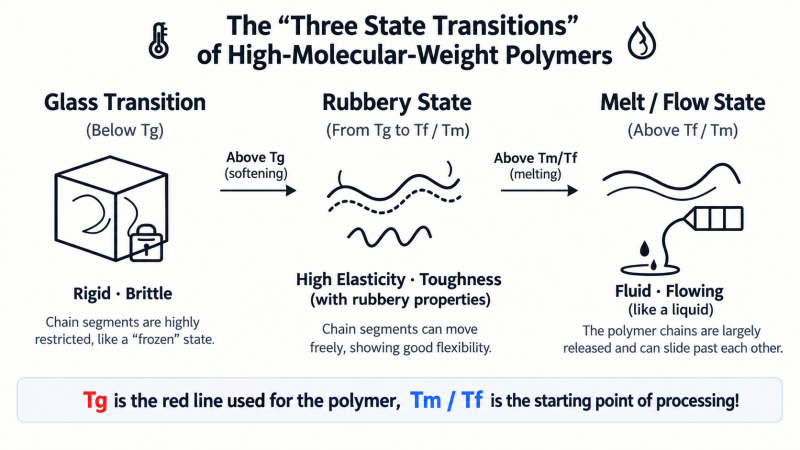
At the microscopic level, when the temperature is below Tg, the material's molecular structure is essentially frozen in place. Macroscopically, the plastic behaves as a hard, brittle, glass-like material.
Once the temperature rises above Tg, local segments of the polymer chains gain sufficient thermal energy to move cooperatively. The material transitions from a rigid glassy state to a more flexible, elastic rubbery state.
In practical processing, Tg has three major implications.
1. Tg and the Service Temperature of Amorphous Plastics
First, it sets a practical temperature limit for amorphous plastics. ABS has a Tg of around 100°C, while PC has a Tg of approximately 145°C. If a PC part operates at 130°C, it is approaching its glass transition temperature and may lose stiffness, creep, or deform under load. For amorphous plastics, Tg is an important reference when determining the maximum service temperature.
2. Tg and Low-Temperature Impact Resistance
Second, it influences whether semi-crystalline plastics remain tough or become brittle at low temperatures. PE has a Tg far below 0°C, while PP typically has a Tg of around −10°C to 0°C. At room temperature (25°C), their amorphous regions are above Tg and remain flexible, contributing to their toughness and impact resistance.
However, if a PP bucket is left outdoors during a freezing winter in Northeast China, the temperature may fall below its Tg. Molecular mobility decreases, and the bucket may become more brittle and crack on impact. By contrast, ordinary non-crystalline PLA has a Tg of approximately 55–60°C. At room temperature, it remains below Tg and is relatively rigid and brittle. If left in direct sunlight on a car dashboard in summer, it may heat above Tg and soften or deform.
3. Tg and Demolding and Drying Conditions
Third, Tg is an important consideration in demolding and drying. During cooling, if the part's surface has not cooled below Tg, it may still be too soft to withstand ejection forces, resulting in deformation or whitening. Similarly, if drying temperatures are set too high relative to Tg, pellets may soften, become sticky, and agglomerate into a solid mass inside the hopper.
Tm (Melting Point): The Point Where the Crystal Structure Breaks Down
The melting point is a distinct transition characteristic of semi-crystalline plastics. Their crystalline regions contain tightly packed, ordered structures held together by strong intermolecular interactions. When the material reaches Tm, these crystalline structures melt, and the solid transitions into a molten state.
In practical processing, Tm directly affects two critical aspects of machine setup.
1. Melt Viscosity and Injection Molding
First, melt viscosity can drop sharply around Tm. As amorphous plastics heat up, their viscosity generally decreases gradually, much like thick syrup becoming thinner. Semi-crystalline materials, such as PA66 and POM, behave differently: once the temperature rises above Tm, their crystalline regions melt, and their flow behavior can change dramatically over a relatively narrow temperature range.
The screw's compression section must provide sufficient heat and shear to ensure complete melting. However, once the melt becomes highly fluid, inadequate mold clamping or poor mold fit can lead to extensive flash during injection.
2. Tm and the Minimum Processing Temperature
Second, Tm defines a critical lower temperature limit for processing semi-crystalline plastics. The nozzle and front barrel zones must be hot enough to keep the melt fully molten. If the temperature falls even a few degrees below the required processing range, crystals may form or partially solidified material may accumulate, causing nozzle blockage, cold-slug marks, and reduced impact performance in the finished part.
Processing tip: As a general starting point, processing temperatures are often set 20–50°C above Tm, depending on the polymer grade, melt viscosity, residence time, and processing conditions. Always follow the material supplier's recommended processing window.
Final Thoughts
Once you understand the roles of Tm and Tg, setting barrel temperature profiles, drying conditions, and mold temperatures becomes much more logical. These two transition temperatures provide a foundation for making informed processing decisions and optimizing the performance of modified polymers.